Hints of spring. Country folk listen for peepers and look out for robins. City
folk notice a sign for "iced coffee, all this week" in a sandwich shop and
start marking their weekend calendars with dates from the Carriage House's
annual spring performance series. Focused in the past on local and imported
dance troupes, this year's series has added two new features: "Re-Verse," a
hip-hop/poetry line-up (the last, on Friday, April 26, features Brooklynite
Lemon, who was captivating, stimulating, and awe-inspiring in performance with
the group Universes two weeks ago); and "Month of Sundays," featuring scenes
and improv with Everett Dance Theatre (matinees on April 14, 21, and 28).
On the dance side of the Carriage House roster, there will be traditional
dances from Cambodia, Polynesia, and the Cape Verde Islands; street tap from
Brian Jones and Donald Suthard; the Philadelphia-based group Bald Mermaids;
and, at either end of this scroll, a salute to modern dance innovators right
here in Providence. Everett and Paula Hunter cap the series in June, and Brown
grad student Zack Fuller kicks it off this Friday and Saturday (April 12 and
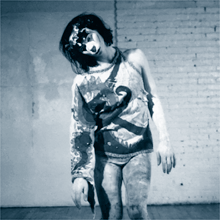
13) with his solo piece, Bloodline, followed by a showcase of
Groundwerx-affiliated choreographer/dancers on April 19 and 20.
Fuller will share the bill with composer/musician Alec Redfearn, performing
with his trio Eyesores on Friday and with Barnacled on Saturday. The pairing is
particularly apt, Fuller said in a phone conversation last week, noting that
audiences should experience his expressive dance movement "like a piece of
music -- it's not necessary to look for a story in it."
Fuller, who trained as an equestrian vaulter and gymnast in his teens and sang
lead in a speed metal band in the mid-'80s, got into theater through workshops
at Jerzy Grotowki's Polish Laboratory Theatre in '89 and '90. In 1997, he
linked up with butoh artist Min Tanaka for The Poe Project at Jacob's
Pillow, and he has since appeared in a dozen of Tanaka's works, across Europe,
in New York City, and several times in Japan.
"I've been interested in the type of physicality of butoh ever since I started
to experiment with movement," Fuller recalled. "But I don't call myself a butoh
dancer. When I was cast in The Poe Project, Min saw that I had something
he could train and work with. His work was more interesting than anything else
I had done, so I kept doing that.
"One of the things I really appreciate about Min is the way he works with
musicians and with space," he continued. "Bloodline is really a
collaboration with me and the musicians [Kenta Nagai, Jonathan Vincent, and
Tatsuya Nakatani]. I'm not imposing any aesthetic on them. They're not under my
direction in any way. They have the freedom to compose their own music."
Though butoh began in the late '50s in Japan, its main connection to Japanese
dance is white body make-up, which Fuller uses but which others who bring butoh
into their work might not. In fact, Fuller emphasized that some consider it a
form of dance and others do not. One thing that seems common to butoh
performers, however, is an intense concentration of physical and mental energy
to convey emotions or images from their often slow, sculptural movements to the
audience.
"Bloodline explores something I couldn't express in words," Fuller
explained. "Personal issues that transcend me but are still framed by my
personal body. I have my own personal bloodline, and I also have DNA, but there
are parts of me that could be a fish or a plant or something that doesn't exist
anymore. There are many other bloodlines that I'm not consciously aware of that
are affecting me. I'm tracing a bloodline that goes back to a time before I was
human."
Fuller hopes that his 50-minute piece will inspire audience members to "the
expanded possibilities for human potential -- the amazing capacity of human
beings to do things we don't consider within our scope."
Choreographically speaking, the artists who will be presenting new works in
the Groundwerx Showcase at the Carriage House rarely see anything beyond their
scope, from punk-rock in metal dresses to lunch-time waltzes to swirling
spirituals.
Groundwerx director Heather Ahern will reprise the Tough Love duet she
premiered last spring with Joan Brazier, sans boots and with larger dolls, the
better to be seen as part of the actual dance (the dolls get their own
puppet-like duet within the piece). Ahern plans to do a solo called
Marseilles that she developed for last fall's Bosch's Harp, which
incorporates, in her words, "pirate-y overtones with the slimy thing that
crawls out from under rocks." Allusions to hornpipe and ballet crop up in
Ahern's fleet-footed steps, set to original music by Steve Jobe.
Ahern and Brazier are also performing a new piece, Admired, set to
Robert Schumann and Nina Hagen ("pastoral to punk-rock," quipped Ahern). Her
characteristic tongue-in-cheek humor comes across in costumes and movement as
well as choice of music. Metallic dresses hang from the dancers' shoulders with
giant hoop skirts but you can see through them to corsets and pantaloons
underneath.
"A lot of my work is about who we are and how it's possible to have two very
different things going on," Ahern reflected. "There's an underneath world that
you can see, but then we bend our knees and go through the hoop. It's like the
shell you wear on the outside and who you are on the inside. I'm dealing with
the multiple personalities you have as a human being and the ways you come to
terms with that.
"And once again I'm exploring what it is to be female," she admitted. "You can
either break out or reconcile. You can be inconsistently consistent and still
be whole. It's o.k. to wear the frilly dress and still do punk rock."
Kathy Gordon Smith, who has danced with Groundwerx in the past and recently
with Ahern in Bosch's Harp, is striving to open up the vocabulary of her
movement to something looser and more humorous -- thus, the working title of
her piece is Loosen Up. Bringing her own ideas together with original
music by Michael DeQuattro, Smith is challenging herself to take more risks
with the composition of the dance.
"Usually I feel like I'm very precise," she elaborated. "I want to get out of
that more. I like to move quickly and I want it to be upbeat and fun."
Similarly, Heidi Henderson, who premiered a new company, elephant jane, last
fall at Rhode Island College and who teaches at Roger Williams University, is
striving for something light, "something up," as she termed it. After
discovering Frank O'Hara's Lunch Poems, which he wrote during lunch
breaks from teaching writing, she realized that she was spending her lunch
times thinking about dance material for her classes.
"That seemed like a good jumping-off place," she related. "To challenge myself
to make a short new piece. It's about getting dizzy and a little bit waltzy. I
will stick a waltz on it, but I don't know if it will hold. It may be called
Lunch Dance or Lunch Waltz."
It falls to Melody Ruffin Ward to insert a note of solemnity into this
showcase. She will be dancing A City Called Heaven, to an a cappella
vocal performance by her husband, Frank Ward, of the spiritual by the same
name. Ward is in her second year of teaching at Rhode Island College. The two
first presented the piece at Brown's Ashamu Dance Theater in February.
"What we tried to do was create a sense of something that was unlike what you
might see in a spiritual," Ward noted. "Not ecclesiastical, but what you'd see
in a real place. "There's something for me that's deeply rooted about the way I
move that is also deeply spiritual," she added. "But I've intentionally stayed
away from moving to hymns and spirituals. This is the first time I've gone back
to that. I wanted it to speak to any viewer, no matter where you are on your
life journey."
And no matter where you are on the spectrum of watching modern dance, you
should find something that will lift you up in the opening programs of the
Carriage House Performance Series.
Call Carriage House at (401) 831-9479 for details.
Issue Date: April 12 - 18, 2002